Four Months After the Myanmar Earthquake: A Long Road to Recovery
31/07/2025
Four months have passed since the major earthquake struck central Myanmar in March this year. Two Japanese staff members of AAR Japan (Association for Aid and Relief, Japan) who are stationed in Myanmar, visited the disaster-stricken areas of Mandalay and Sagaing. While reconstruction efforts are underway in the towns, aftershocks continue to occur, and the situation remains far from enabling people to rebuild their lives. AAR Myanmar Representative Yamamoto reports from the field.

A large pile of debris protruding into the center of the road in Mandalay, central Myanmar, July 16, 2025
About an hour and a half north of Yangon by air, Mandalay city is bustling with motorcycles and three-wheeled taxis, and shops and markets are lively, giving the impression that it has regained its vitality. However, piles of debris from the demolition of collapsed buildings line both sides of the road, and sand and building materials for reconstruction remain piled up. When I opened the car window, the dust from the ongoing restoration work throughout the city made my eyes sting. At a restaurant in an area with many students, sales have dropped by half, showing that the impact on people’s livelihoods is still ongoing.

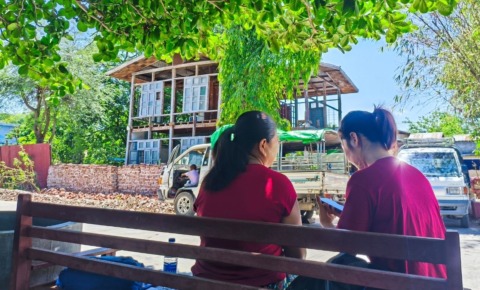
A woman (second from left) talking about her late husband
This earthquake caused 3,700 deaths and over 5,000 injuries. There have been over 200 aftershocks since then, and the survivors are still living in anxiety.
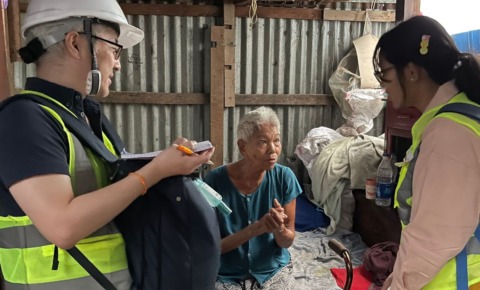
“He was a family man and a very kind husband. I never thought we would part like this.” A woman in her 50s living in a concrete house in a village on the outskirts of Mandalay said tearfully. Her husband, who was in poor health, died of a heart attack amid the chaos of the earthquake.

The woman’s late husband (second from left)
The floor and walls of their home remain cracked, and the water leak has not been fixed. “This is the house we built with the money we saved by selling chewing tobacco, and it’s full of memories,” she said, her voice breaking.
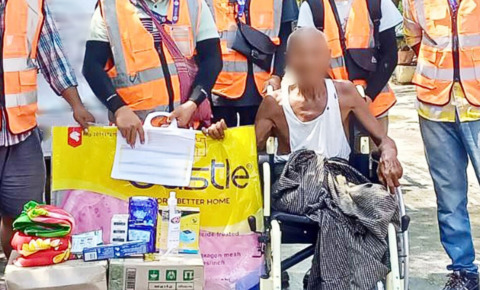
The cash assistance provided by AAR in May was used to purchase food and cover her children’s education expenses. “My husband taught our family how to sell chewing tobacco, and now my second daughter has taken over to support the family. We don’t have the means to repair our home, but we must persevere for the sake of our late husband and the family he left behind.”

The residential premises reduced to a pile of debris after demolition
A woman in her 60s who lived in a two-story house in Mandalay City wept bitterly in front of her home, which had been reduced to a pile of debris. “We can only afford to borrow money from relatives to demolish it. We have no means to rebuild it.” She reportedly sleeps on a makeshift bed made of wooden planks under a vinyl sheet roof set up in a corner of the yard.

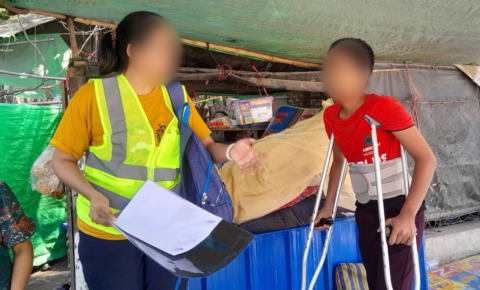
A makeshift bed set up under a vinyl sheet. She sleeps here every night
Before the earthquake, she ran a tailor shop, earning a living by sewing blouses for about 260 yen each. However, the earthquake destroyed her sewing machine, cutting off her income. She said she used the cash provided by AAR for medical expenses and added, “I am truly grateful to everyone in Japan for their support. I have lost my income and my home, and I can’t see a future. Please continue to help us.”
During my stay in Mandalay, I experienced several strong aftershocks. Even nearly four months after the earthquake, disaster survivors continue to live in fear of aftershocks, spending anxious nights in their damaged homes, nearby monasteries, or outdoor temporary tents.
Much more support is still needed to rebuild the lives of those affected by the disaster. We kindly request your cooperation in AAR’s support for the Myanmar earthquake.
Please support
We appreciate your kind donation for our emergency relief efforts in Myanmar Earthquake.